
Foam Slitter
 Previous

From Scratch
This write-up is about a project which involves Foam Formation and alleviating Electromagnetic Frequency Interference whilst building a Foam-Slitting machine from scratch.
For another Project write-up in the Industry of Foam Formation, here’s Foam Forming with Canon Viking – 2M Automation , whilst Boundaries of Sound & Space – 2M Automation also touches on the issue of EMF interference in another 2M Project.
This product was a step beyond off-the-shelf products because it is the first machine of its kind to be Programmable Logic
Controller (PLC) based with a bespoke design. Machines made prior to this development were very clunky and were known to have
many unknowns as access and visibility to various components was very limited.
The original specification was for a non-PLC based system to control:
- 4 blades
- 3 conveyors, and
- 4 grinders

Safety Trials
During R&D, 2M discovered that a non-PLC system would struggle to properly diagnose and supervise the processes carried out by the machine in a safe manner.
Therefore, the Company determined that a PLC control system would need to be incorporated into the machine to take charge of all the functionality.
The machine was to be located in the end of a production line where the foam, after passing through extrusion, enters the machine in a three layer format, so that it may be slit and then exit the machine for operators to handle.
The four blades inside the gated machine slit the foam which created the need for extra safety features to ensure the safety of the operators from both the blade and the grinders.
The machine included an infeed conveyor which fed the product and a mid-feed conveyor which fed the material into the blades. The outfeed conveyor exits the product to the operator. There are two grinders per blade which run continuously whilst the blades
are running to ensure that the blades are being sharpened.
Due to the high risks involved, the machine is fully gated with four solenoid activated gates plus further gates to ensure no unauthorised access is granted to operators whilst the machine is running. There is also functionality to allow for manual sharpening of the grinders.
By the end of the project the machine had:
- a much improved throughput,
- flexibility to adjust the speed of the machine due to the design synchronicity,
- the ability to perform high-risk operations whilst keeping the operators safe.
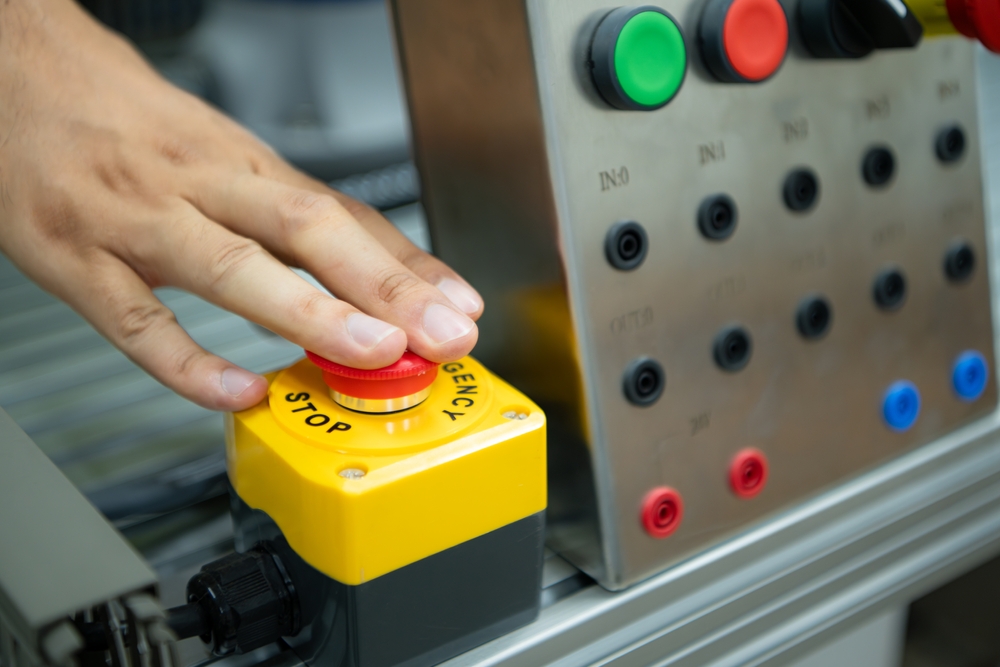
One particular aspect that created much uncertainty was that around operator access to the various parts of the machine which
are high-risk.
The system was originally designed to only allow access to the machine, i.e. opening the Safety Guard Switches, once all the drives
including the Blades Drives were disabled and at zero speed to eliminate any hazard and risk to the Operators. However, the
Company were had a requirement to change this protocol which meant that the safety gates would open whilst the blades were
still coasting to a stop so that the Operators could get hold of the product inside the machine in time to avoid excessive product
waste and possible jams which cause major machine downtime when this occurred in existing machines.
To achieve the above the Company had to precisely measure the stoppage time for all the blades at different speeds and for
different scenarios to ensure there was enough time for the blades to stop upon entry of the operators, therefore minimising risk
to the operator and at the same time avoiding the machine jamming whilst still maintaining the Safety Integrity Level (SIL)
required by the design.
A further uncertainty arose due to the fact that the machine was extremeley large and therefore not easy to transport from the
Company’s premises where it was being built to the customer’s site where it was to be installed. To overcome this uncertainty the
Company determined that the machine would need to be designed to be built in three parts. A system of plugs and sockets as
well as routing for the cables around the machine then had to be designed and constructed to provide required connectivity and
also allow for disassembly for transit. Due to the tight space available for the electrical panels this proved particularly
challenging.
A further uncertainty faced was that when the machine was moved to site it experienced Electromagnetic interference (EMF) with
the functionality of the drives. Before the machine was moved over to the end user it was tested in the manufacturing base and
all functionalities worked correctly, however, once it was moved over to the end user, the Company started to recieve functionality
issues with the machine whilst it was in production. Whilst out on site it was reported that a number of the 11 drives that the
machine contained were cutting off i.e. stopping and then restarting in the middle of the operations with the issue gradually
getting worse over time eventually resulting in issues with all of the drives.
To try and overcome this technological uncertainty the Company carried out further diagnostics and site visits and determined
from these investigations that the safety enabled signals to the drives were being affected by EMF interference that was present
within the factory.
The Company first tried to find a solution for this by hardwiring the safety enabled signals and found that, whilst this would
remove the problems completely, it also meant that the drives would remain enabled on E-Stop activiation which would pose
significant risk to the operators. Therefore, temporary safe operational and maintenance provisions were made and agreed with
the client whilst further investigations were carried out to find the route cause and remedy for the interference.
After many attempts, weeks of offline software development and many tests, the Company finally arrived at the required solution
to the interference. The Company found that it had to disable the Output Signal Switching Device (OSSD) on all the Safety Output
Cards and remove the hardware links (the above hardwired solution), which therefore left the machine in a safe operational mode
and free from any EMF interference